
Where La Plata County Arrest News Appears
Start with the agencies themselves. The Inmate Search gateway at the La Plata County Sheriff's Office sends custody lookups to Colorado VINE. It hosts no roster of its own. No daily bookings feed or public mugshot gallery exists on the sheriff's site either. What the sheriff and the Durango Police Department do publish shows up on their county pages and social accounts, where a post might explain a major arrest, request tips, or note an incident was closed.
For steady crime coverage, turn to the Durango Herald Crime and Public Safety section. It's the best bet around. Stories run when events warrant. There is no fixed schedule. Reporters lean on Durango police, the sheriff, court filings, and interviews, so expect a mix of scene shots, agency photos, news photography, and the occasional image of a person involved. This is journalism, not a booking log. A missing name means little.
Two regional outlets round things out. The Durango Telegraph keeps archived "Quick 'n' Dirty" briefs plus longer pieces, though no current blotter or photo section stands out there. The Journal's Crime section covers Four Corners cases that reach La Plata County. Its home turf is Cortez and Montezuma County, though. Check dates and jurisdictions before relying on either.
Note: No dependable La Plata County television or radio arrest-photo section was documented, so none should be treated as a standing feed.
La Plata County News Outlet Map
Each source answers a different question. Government channels show what an agency chose to release. Newsrooms add reporting and context that a press post never will. Secondary directories can point you toward a facility, but they sit below the official record. The table below keeps those roles distinct, with county and city sources listed ahead of publishers.
| Outlet | Coverage | Photos? | Where to check |
|---|---|---|---|
| La Plata County Sheriff’s Office | Selected releases and public-safety posts | Sometimes, when the agency releases one | Official county site and linked sheriff social channel |
| Durango Police Department | Selected city incidents and notices | Varies by post | Official police page and linked channels |
| Durango Herald | Ongoing Durango and countywide reporting | Story-specific; no mugshot gallery | Crime and Public Safety section |
| Durango Telegraph | Regional narratives and archives | Occasional news images | Dated archive or relevant story |
| The Journal | Regional Four Corners stories | Story-specific | Crime section; confirm La Plata connection |
| Third-party directories | Incomplete or historical listings | Varies; never authoritative | Only after checking official records |
A headline moves fast, but it settles nothing legally. A sheriff's post can hit the web before charges are even filed, and a court case may end up going somewhere entirely different once judges and lawyers get involved. So match your question to the right source. VINE, reached through the county gateway, answers whether someone is in custody right now. The sheriff's records request is the tool for an old booking photo from a county intake. Want the outcome of a case? That belongs to the Colorado courts.
La Plata County Sheriff News Sources
Skip the app store for this one. The La Plata County Sheriff's Office has no verified inmate app. Its official custody channel is the web-based VINE service, which can also send notifications where available. Social media fills a different role. Posts from the sheriff and county emergency alerts may flag a threat, describe a notable case, or ask the public for tips. Still, they are selective. They often leave out both the booking photo and whatever the court later decided.
That gap matters when a post travels faster than the paperwork behind it. Write down the agency name, the post date, an incident number, the full name as reported, and the date of the event. Then check whether the person shows up in current county custody. Sometimes they won't. There are routine reasons for that. Intake paperwork may be incomplete. The person may have been cited or released. Another agency may hold them, or the name was keyed in differently. Call the La Plata County Detention Center at 970-247-1161 for live custody questions. For a past booking, a targeted request to the Sheriff's Records Division at 970-247-1157 is the stronger route.
Note: Agency alerts describe selected events; they are not substitutes for the complete booking record or the court’s final order.
How La Plata County Photos Reach News
In Colorado, a booking photograph counts as part of a criminal-justice record. Even so, La Plata County does not display every booking image in a public gallery. A newsroom might get an image through an agency release. It might also pursue one by records request. The official LPCSO paper form lists "Booking Sheet/Mugshot" right on it. A good request names the person and gives an approximate arrest or booking date. Add an incident or booking number if known, plus the location and arresting agency. The custodian can withhold or redact protected material when the law allows. That includes juvenile, sealed, security-sensitive, victim, medical, or active-investigation content.
State law adds one twist. Colorado's criminal-justice-record law requires anyone requesting a booking photo to affirm they will not use it in a publication that demands payment or value for its removal. That rule is a big part of why access here works by request. It does not force release of every photo. A release is not the end of the story either. Booked charges reflect intake only. Prosecutors or the courts may change or dismiss them later.
La Plata County Arrest Blotter Pattern
La Plata County has no public web blotter. Local reporters still get arrest facts through an official channel. Durango Police policy section 346.4 requires a daily information log of significant activity and arrests. Media representatives can request it through the shift supervisor. The arrest entries can list the date, time, location, case number, name, birth date, and charges. Release may be withheld if it could endanger someone or harm an investigation. Photos are not promised. The policy creates no public named-arrest feed.
That explains a curious gap. A journalist may hold official booking facts while a reader cannot open the same daily list online. It also separates news selection from a complete booking window. LPCSO publishes no verified 24-hour, 48-hour, 72-hour, or weekly roster. Someone booked and released quickly may drop out of a current-custody search. The booking sheet remains available by request. A name in a police release may also reflect a citation or a different custody system.
Each agency holds its own material. The arresting agency keeps the incident report. The sheriff keeps the county-jail booking record. A Durango event can therefore mean a DPD report plus a separate LPCSO booking sheet. Bayfield and Ignacio police maintain their own agency records too. Neither town has a public named blotter. For the countywide picture, see the La Plata County busted mugshots search.
La Plata County Aggregator Audit
Third-party arrest sites should be a last stop, not a first. Their pages can be stale, incomplete, duplicated, or simply wrong. Check official custody, records, and court sources first. Among the five best-known brands, only one has a genuine La Plata County landing page. Busted Newspaper shows no verified local section. Arrests.org results mentioning La Plata actually point to records from other counties. Mugshots.zone has no verified county endpoint. Inventing a substitute URL for any of them is a mistake waiting to happen.
The RecentlyBooked Colorado index is unofficial and subject to change. The state index has not shown La Plata County listed. That absence says nothing about whether an arrest occurred.
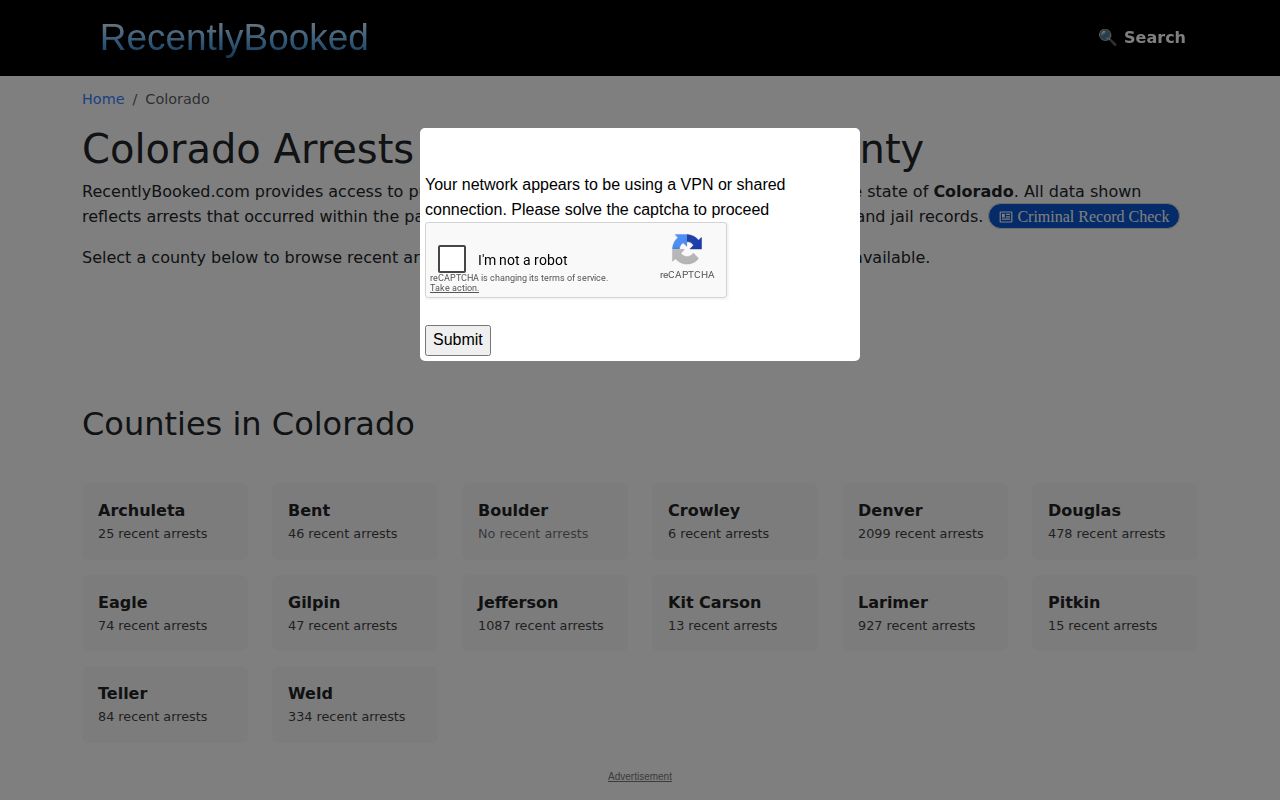
Any image of these aggregator pages is just a snapshot of a moment. It is not a county booking feed. Its counts or county list can go stale.
The Mugshots.com La Plata County page is unofficial. It looks more like an archive than a current roster. Its visible inventory concentrates on arrests from 2011 through 2017. Anyone hoping to learn who is in custody now will not find the answer there.
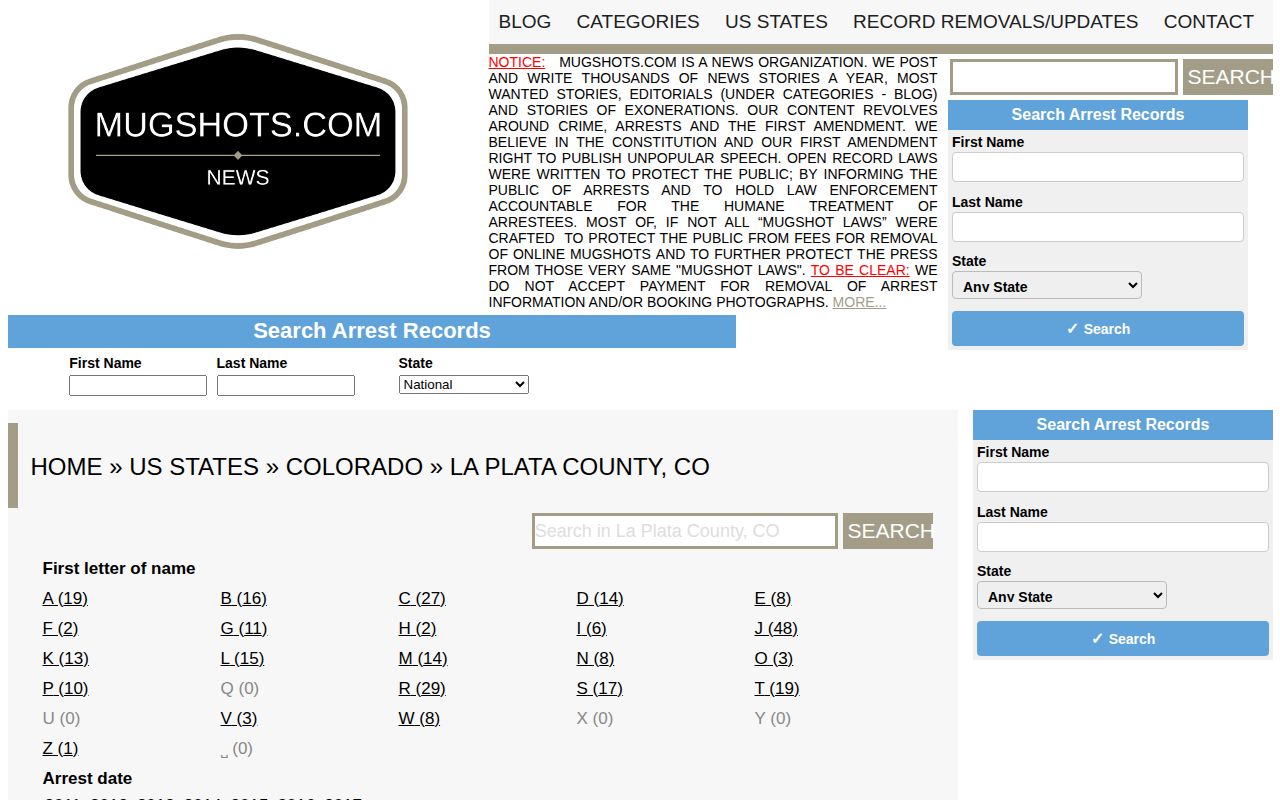
A screenshot of the county index shows no individual booking portrait. Each entry must still be verified against government records for identity and custody status.
JailExchange also runs a La Plata facility page. That one is an unofficial directory. Its prose is generalized, not an observed sheriff feed. It does point readers to a search tool and the official booking phone number. Even so, it cannot establish a local photo policy, an intake lag, or an update schedule. Treat it as a signpost, not a source.
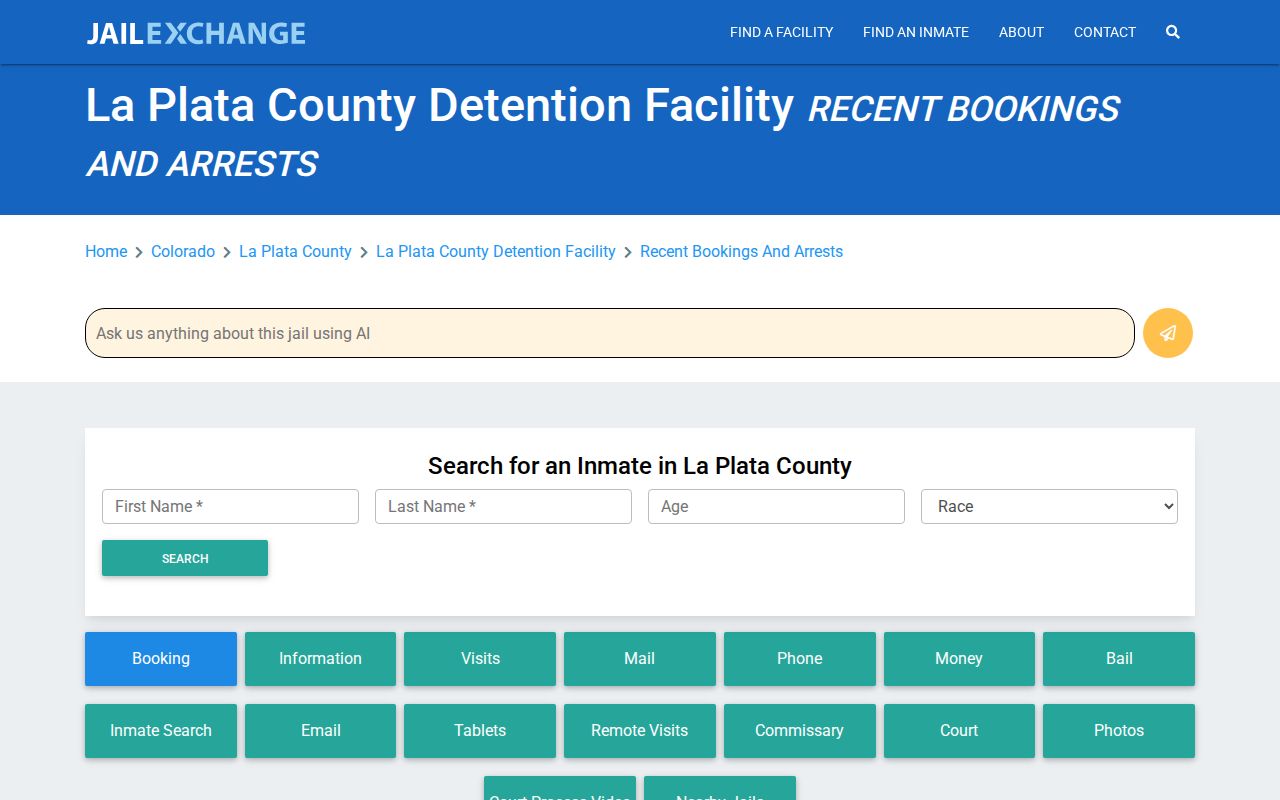
Pages like these are useful only as landscape evidence. For anything that matters, the La Plata County Sheriff's Office, VINE, and Colorado courts remain the sources that can confirm where a record stands.
Trace La Plata County Arrest Stories
A name in La Plata County arrest news is a starting point. It is not an ending. Start with the date and agency named in the story. Then chase the record that agency holds. Finish with the booking and court systems, which show different stages of the same matter. Keep spelling, birth information, case numbers, and dates aligned throughout, so records for people with similar names never get mixed.
- Identify the source and agency. Note whether the report names LPCSO, Durango Police, Bayfield Police, Ignacio Police, a state agency, or a federal or tribal authority. The place alone does not decide who holds the record.
- Check current county custody. Use the official LPCSO gateway to VINE. It answers whether someone is reported in county custody, not whether every recent arrest occurred, and it does not guarantee a photograph.
- Request the booking record. For a county-jail intake, use the LPCSO Records Requests page and ask narrowly for the booking sheet and mugshot. Seek the arresting department’s incident record separately.
- Find the court case. Search the Colorado Judicial Branch docket with La Plata County selected for county or district matters. A Durango municipal ordinance case may instead remain in municipal court.
- Confirm the disposition. Review the register of actions and final order, or contact the Sixth Judicial District La Plata court. A docket date alone is not a judgment.
Custody can shift before a story catches up. Release from jail is not the same as a dismissed charge, and continued custody is not the same as a conviction. A transfer to the Colorado Department of Corrections moves the person into the state offender system, while federal and immigration custody each use separate locators. The final court record, not the mugshot or the headline, completes the account.